FOIA powered migration story

FOIA stands for the Freedom of Information Act (1967), and this act gives the public the right to disclose public information controlled by the U.S. government. FOIA helps the public such as journalists to request public information from the government that could support their stories and inform the reader.

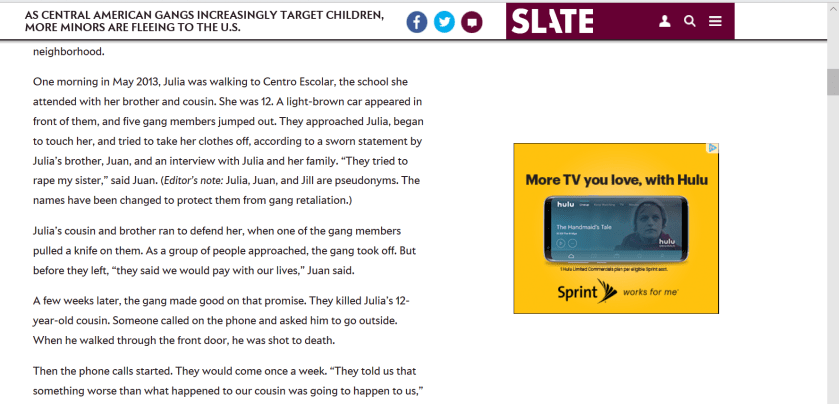
Looking through different public stories that are FOIA powered stories, and these public stories were disclosed by the U.S. government. The story I chose to discuss is titled As Central American Gangs Increasingly Target Children More Minors are Fleeing the U.S.

This story is talking about student gang members in central El Salvador. A gang has sexually assaulted a 12 year old girl and killed her cousin. The article goes on to talk about how the girl’s parents had to migrate to the U.S. and wanted to have their kids join them mainly for safety reasons. However, the family didn’t end up having the kids come to the U.S. because at the time the U.S. government paid $130 million to increase security on the U.S. Mexican borders.

As an American, I want to have protected borders; however, reading migrants’ stories and knowing the reasons behind their immigration make me have mixed feelings especially if that could help a child’s life.
FOIA


Twitter account worth following

The person I am following on twitter and that I am aggregating coverage from is professor Stein Brunvand. Professor Stein Brunvand is the Associate Dean for the Master’s programs, and an Associate Professor for the Educational Technology program at the University of Michigan Dearborn. Stein Brunvand is the director for the educational and instructional technology programs.Therefore, professor Brunvand can be a help source to increase my knowledge in the instructional technology field and that makes him worth following.  

brunvand.PNG

My social media aggregation accounts

The social media that I have been using for years in my personal life are Snap chat, Instagram, and YouTube. However, I haven’t been using social media in my academic life as much. The social media I have been using to post resources and some of my academic work is Weebly, and I use Weebly as my e-protfolio.

blog15

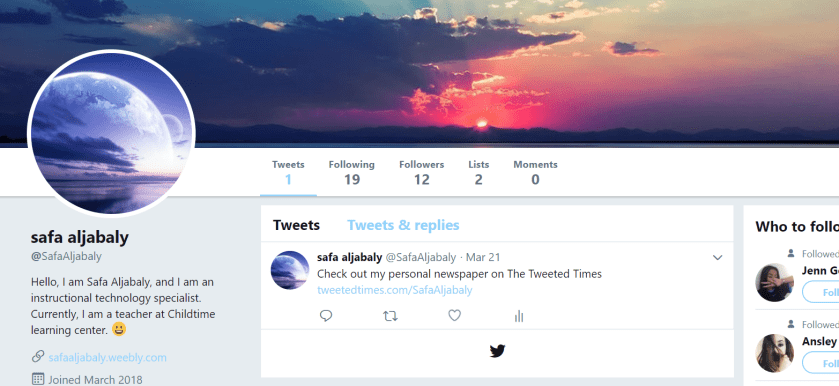
I recently just started using Twitter to follow accounts that will benefit me in my field and area of study which is instructional technology. This is my Twitter account, and I started following pages and accounts that are connected to instructional technology. Also, I started using Tweetdeck to create different lists related to technology and education. I started to use Nuzzel and Feedly to aggregate helpful websites and resources.

twitter

News publications about Stephen Hawking after his death

After the death of Stephen Hawking, a lot of news websites published stories about Hawking’s life and his work. The New York Times published a story on March 18, and it was titled Stephen Hawking Died at Age 76: His Mind Roamed the Cosmos. The BBC News website published a story on March 14 which was titled Stephen Hawking: Visionary physicist dies aged 76.  The Washington Post news website published an article on March 26, and it was titled No, Stephen Hawking did not suddenly believe in God on his deathbed. The USA Today news website published an article on March 19 and was titled Do we live in a multiverse? Stephen Hawking submitted a final paper days before his death.

There are many more news websites that have published stories about Stephen Hawking after his death. The mentioned stories above are examples of some of the news websites which published stories about Hawking after his death that are covering information on his work and life.

hawking


Aggregation example story

University of Michigan students pay different annual costs depending on which of the three campuses the students are attending. The University of Michigan Ann arbor has the highest annual cost for attendance where the annual cost for in-state students is between $29526 and $31396. Out-of-state students pay annual cost that is more than the double of the in-state students’ annual cost, where the annual cost for out-of-state students is between $62176 and $65508.

The University of Michigan Flint has the second highest annual cost between the University of Michigan campuses. The Flint campus has a total annual cost of $24526, where the  cost is divided between tuition & fee, room & board, books & supplies, transportation, and personal expenses. Lastly, the University of Michigan Dearborn has the lowest annual cost compared to the Ann arbor and Flint campuses. The annual cost for the University of Michigan Dearborn is $13772 for in-state students and $26006 for out-of-state students.