A good aggregation example

I found an article in the NY Times website titled NASA’s Webb Telescope Faces More Setbacks, and it is a good aggregation example. This article is a good example of an aggregated story because the article included a set of different resources and information about the covered story.

This article is talking about a NASA project which is a space telescope that has been delayed until 2020. This article is only telling the story of the telescope NASA project and providing multiple contextual links of resources to backup the story and to give the reader further information on the topic.

aggregation

A good example of a curated story

In Ron French’s curated story, he first presented and quoted the topic that Betsy DeVos discussed in the 60 Minute interview. French did not include his opinion in the story; rather, he curated multiple sources that explain how Michigan education is getting worse each year.

As a reader of French’s story, I was convinced by the data provided that the education in Michigan never been worst. French didn’t make any claims in the story; rather, he provided evidences of data, research, and facts that stated to the reader that Michigan education system is only going downward.

French used multiple resources in his story. Two of the resources that French presented in the story are Michigan spent $80 million to improve early reading and NAEP Data Explorer. The first source is Michigan spent $80 million to improve early reading which is one of French’s publications in Bridgemi.com. Second source is NAEP Data Explorer which is retrieved from the nces.ed.gov.

French used different resources in the story to state the facts that indicate that the education system in Michigan is only getting worse each year. The NAEP data showed the academic achievement level across the state of Michigan.

French introduced “contextually links” to make sure the reader knows some information about the source mentioned in the story, also he provided links to the actual source. For instance, Brian Jacob was one of the sources in French’s story. French provided a link to Brian Jacob’s page that has more information about him “…according to the analysis by Brian Jacob, a University of Michigan professor of economics and education.” (French, 2018).

14


How to minimize biases in our reporting

Where we are from, our gender, religion, family, friends…etc. can affect our reporting and the way we view things. The fact that I am a female, a Muslim, and Arab American has effects on how I view the world. Even though a lot of times we try to get rid of these biases, we will still end up with some unconscious biases.

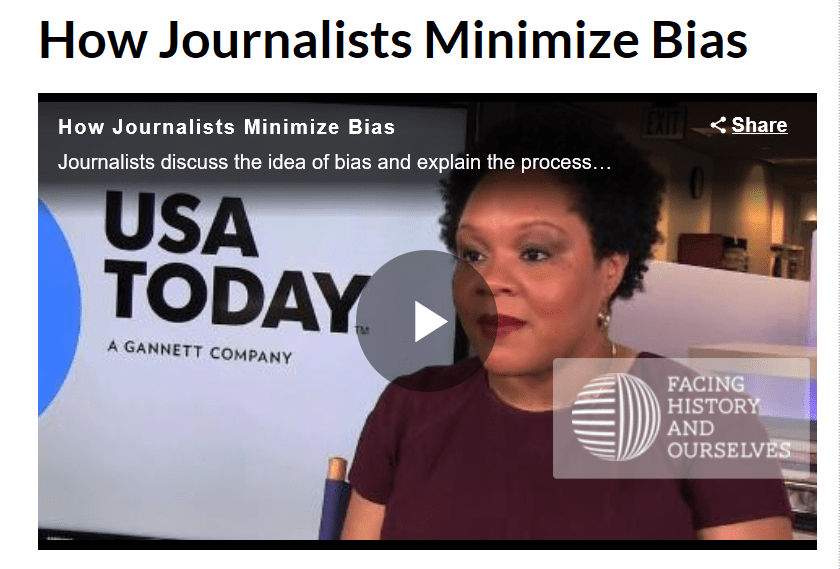
As mentioned in a video titled How Journalist Minimize Bias, we need to be aware of our biases and the facts that could affect the way we view the world. Also, collecting different resources about the reported subject will minimize the biases in our reporting because we are exposed to different angles of the same story. Lastly, talking to different people regarding the reported subject will give us different insights of the story which can minimize our biases as well.

To balance our reporting, we need to focus on the process of collecting different sources, talking to different people with different perspectives, and being aware of our own biases and what could affect our reporting such as ethnicity, gender, religion,…etc.


bias
This is an image of a video titled How Journalists Minimize Bias which includes different ways to help minimize biases in reporting and writing.


FOIA powered immigration story

FOIA stands for the Freedom of Information Act (1997), and this act gives the public the right to disclose public information controlled by the U.S. government. FOIA helps the public such as journalists to request public information from the government that could support their stories and inform the reader.

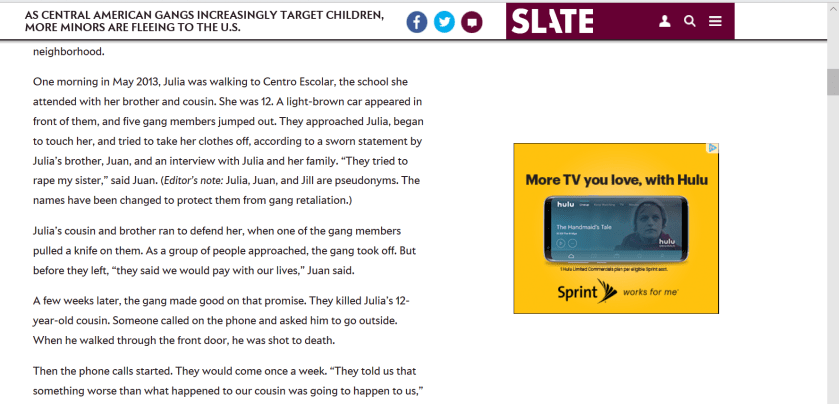
Looking through different public stories that are FOIA powered stories, and these public stories were disclosed by the U.S. government. The story I chose to discuss is titled As Central American Gangs Increasingly Target Children More Minors are Fleeing the U.S.

This story is talking about student gang members in central El Salvador. A gang has sexually assaulted a 12 year old girl and killed her cousin. The article goes to talk about how the girl’s Parents had to migrate to the U.S. and wanted to have their kids join them mainly for safety reasons. However, the family didn’t end up having the kids come to the U.S. because at the time the U.S. government paid 130 million dollars to increase security on the U.S. Mexican borders.

As an American, I want to have protected borders; however, read migrants’ stories and the reason behind their immigration makes me have mixed feelings especially if that could help a child’s life.

FOIA


What makes a good lead

A good lead has to be informative, where it has to explain the what, when, where, why, who, and how of the story. Also, a good lead has to have a good headline that draws the reader and gives information on what the story will be about.

The KFC Has a Problem in Britain: Not Enough Chicken article in the New York Times is a good example of what a good lead looks like. The 5 W’s and H were answered in the lead of the story. The lead of the KFC Has a Problem in Britain: Not Enough Chicken article had a good headline, where I was drawn into the topic just by reading the first two sentences in the article. The lead of the KFC Has a Problem in Britain: Not Enough Chicken article summarized the main idea in the whole story. As a reader, I was able to know what the article was going to be about just by reading the lead of the article.

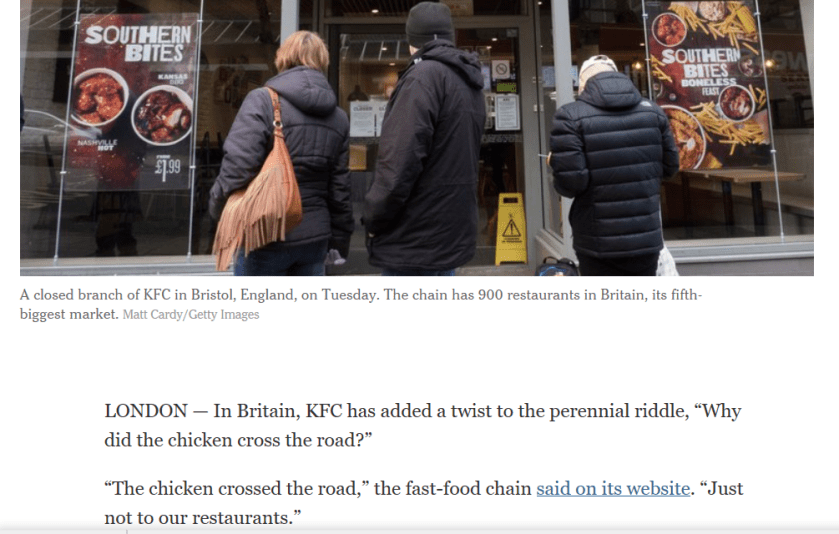
The KFC Has a Problem in Britain: Not Enough Chicken article is a well-written article because it had a good lead, and it included a picture, resources, and links to support the information presented in the article. The provided resources in the article gave it more credibility to its readers.

I googled the headline of the KFC Has a Problem in Britain: Not Enough Chicken article, and the first option in the google search was the actual article in the New York Times website. The second option in the search was a YouTube video from the CBRT news that is talking about the same story. However, there were no images shown in the google search, and I had to go to google images to see the image that was in the New York Times post as the first image.

blog9