How to minimize biases in our reporting

Where we are from, our gender, religion, family, friends…etc. can affect our reporting and the way we view things. The fact that I am a female, a Muslim, and Arab American has effects on how I view the world. Even though a lot of times we try to get rid of these biases, we will still end up with some unconscious biases.

As mentioned in a video titled How Journalist Minimize Bias, we need to be aware of our biases and the facts that could affect the way we view the world. Also, collecting different resources about the reported subject will minimize the biases in our reporting because we are exposed to different angles of the same story. Lastly, talking to different people regarding the reported subject will give us different insights of the story which can minimize our biases as well.

To balance our reporting, we need to focus on the process of collecting different sources, talking to different people with different perspectives, and being aware of our own biases and what could affect our reporting such as ethnicity, gender, religion,…etc.
 

bias
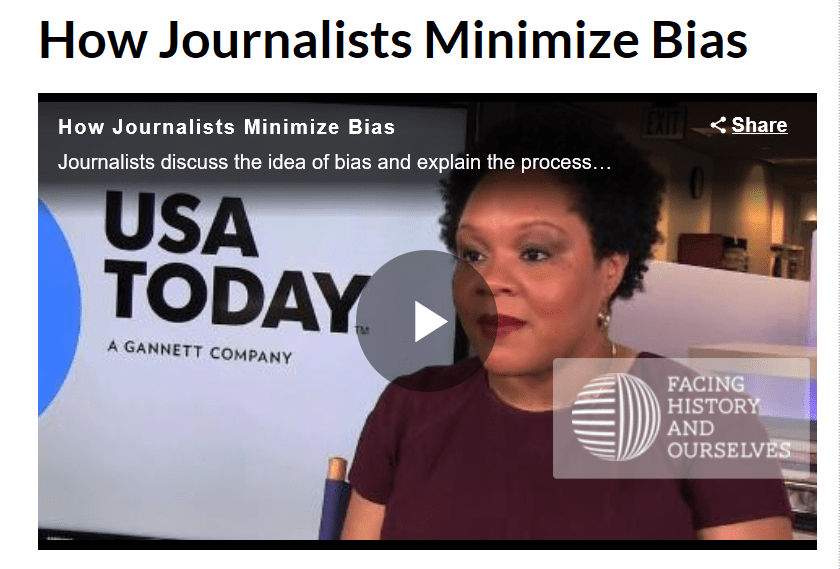
This is an image of a video titled How Journalists Minimize Bias which includes different ways to help minimize biases in reporting and writing.


Avoid being biased in your writing

Ethics is very important when it comes to journalists.  The SPJ website has a video on how journalists minimize bias. The video talks about how not all journalists are the same, and how journalists are diverse people.

The common topic that was used was ethics and how journalists are neutral and everyone has their own opinion. The video really helps journalist learn more about the importance of fact checking and how to be creative in your writing without being biased.

When it comes to my reporting I feel like I should put other peoples feelings and opinions in perspective. I know that I have to have an open mind when writing and not believe that I am always right.

It’s very important to avoid being biased in your writing because everything you write is in the public eye. It’s always important to focus on the real facts and also feelings. It’s always important to use some sort of feeling into your writing but it should let it affect the facts that you are trying to put out.

Avoiding bias in journalism

When writing an article, I write with an open mind. Most of the events and organizations that I cover focus on positive things, so there are no true negative feelings within my stories.

However, this mindset did not occur last year when I was covering the Planned Parenthood protests. My article was biased towards Planned Parenthood, and I discussed how important it was to keep the non-profit in our communities. During the protest, I didn’t talk to the side that was against Planned Parenthood. This showed where my bias was placed, favoring Planned Parenthood and not acknowledging the opposing side.

The publication that I was working for at the time also accidentally published it before editing it. So not only was it biased towards one side, but it hadn’t been cleared by anyone.

Since this incident, I have been very careful about what I write and to make sure that it is not biased. The journalism career field does not accept bias, because as a journalist, you are supposed to tell the story through someone else’s perspective.

It was a true learning experience for me, and it definitely placed fear within myself. Knowing that an issue like this can get you shamed by other journalists and the public is a scary thing.

What’s fair- ethics drive journalism

SPJ included a video of journalists in one of their articles who spoke on the topic of ethics where one of them mentioned that though journalists are trying to remain neutral, they do in reality have opinions. However, accuracy is more important and is a priority above all else, one journalist simply says it’s “what’s fair.”

SPJ includes a video in their article on what journalists think about bias.

As a reporter, a journalist tries to get every perspective. One source cannot run a story because it is begging for bias. Sources must be verified and reporters do this by going to more than one source to check and balance their stories. One journalists puts it like this; If a mother had a child who did something wrong and said that that same child was a straight A student and never got into any trouble with the law, one can’t quickly take her word for it. Rather, it’s important to go to the child’s school and police department to check out those sources as well. It might not be that the parent is lying, yet she may be overcome with grief and feel as if she has to prove her child is pure, just like most parents think their children are.

SPJ gives examples of different articles and how they fit ethical journalism.

SPJ puts it clearly: “SPJ Code of Ethics- seek truth and report it, act independently, minimize harm, and be accountable and transparent.”

SPJ’s perspective on what ethical journalism calls for.

VIDEO: How journalists confront their own biases

This is a video from the Society of Professional Journalists. It features journalists talking about bias, and how they confront both their own biases and those biases others see in them. It’s worth viewing. I can’t actually embed the video, but if you click on the image it’ll take you to it.

Journalists speak about bias in this SPJ video.