
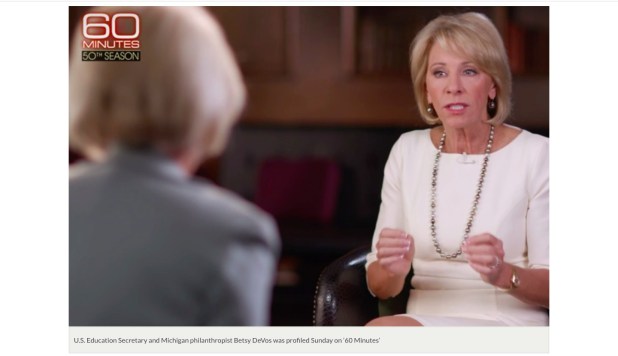
Curated story on Betsy DeVos

bt 4

When reading Ron French’s curated story about Betsy DeVos, he presented facts that backed up what he was saying. For example, when answering how Michigan schools are really doing, he linked an article to the following statement, Michigan is “dead last among states in improvement in math and reading.” When looking on the article, we can see that Michigan, as well as West Virginia, South Carolina, and Alaska are struggling with maintaining the average growth.

French contextually linked articles and websites throughout his story. When reading, I didn’t know what the National Assessment of Education Progress (NAEP) was, until he linked the website. It is a detailed data base of national and state assessments.

I liked that his story can be easily readable. It wasn’t overly complicated with statistics or bunched up with his own opinions. He presented the story as it is, with facts that backed up his word.

Michigan schools fail to improve

Michigan schools are not improving. Even worse, they seem to be in decline.

Ron French’s story on Betsy DeVos’ “60 Minutes” interview aggregated stats that indicate Michigan’s school systems by and large have been in getting worse.

In some instances Michigan has been seen in last place among improvements in math and reading, according to French’s source at Brookings.edu. Third-grade reading scores have also been shown to be in decline, according to Bridgemi.com.

What these sources show is that according to experts and other reporting, despite Michigan spending money to improve, it is not working.

What French’s story shows is that studies from a variety of places, and statistics from multiple sources as well as experts, indicate the lack of improvement among Michigan’s schools.

FOIA, e-cycling in Michigan

muckrock

When looking on Muck Rock, I found a request that was submitted and is completed. The request is asking for documents from 2013, 2014, 2015, and 2016 from electronic manufacturers to see if they are following the obligations of e-cycling, in Michigan. Some manufacturers include Dell, Samsung, LG, Sony, and Microsoft.

The Michigan Department of Environmental Quality (DEQ) responded and forwarded the request to the Waste Management and Radiological Protection Division of DEQ. A fee of $99.75 needed to be paid to satisfy the request.

After the FOIA request was satisfied, DEQ sent in six separate emails containing the documents that were requested. There were some manufacturers that didn’t have the documents because they weren’t registered.

This non-profit news site makes requesting government documents easy, if needed.

Using Google fusion tables

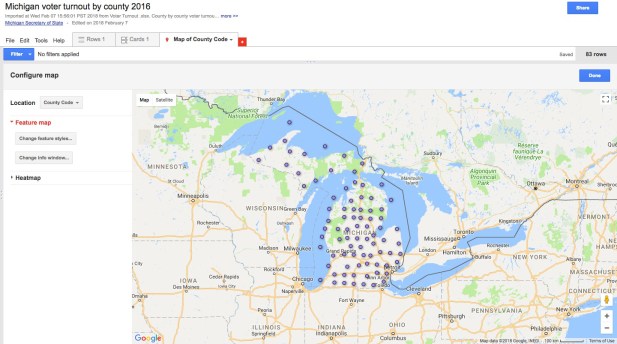
Google fusion tables is a new type of tool for me to use. The step-by-step guide helped me create the fusion table. First, I looked up the the voter turnout in the State of Michigan in 2016. I downloaded the excel document and edit a few things on there, such as, deleting the county code.

1

I downloaded Google fusion tables through Google Drive and uploaded the excel document on there. After that, a map of Michigan and dots appear. Now, I can share this map with anyone.

Comparing 4-year colleges in Michigan using a data set

One of the main reasons why I came to the University of Michigan – Dearborn was because of how close the university is from my home. Based on the comparative report, the University of Michigan –Dearborn for in-state students are:

  • In-state tuition: $9,788.00
  • Books & supplies: $960.00
  • Room & board: $1,600.00
  • Transportation: $1,556.00
  • expenses: $1515.36
  • Total: $15,419.36

Screen Shot 2018-02-14 at 8.48.43 AM

I do not know exactly when this report was created, but mlive, a local and statewide news group, they reported on 15 universities in Michigan about their tuition cost in 2017-2018. Here is the information that they reported on the University of Michigan – Dearborn.

4

  • Tuition and mandatory fees: $11,792;
  • Room and board: $8,272*;
  • Total for tuition and room/board: $20,064;
  • Estimated total cost of attendance: $25,330.

The asterisk indicates the cost of living off campus because UM – Dearborn is a commuter college.

As you can tell, the cost of attendance has gone up immensely. While reading the mlive article, they linked another article about the difference between paying for college then and now. This article shows some data reports on the average in-state tuition from 1975 until 2016. When reading this article, you can see the difference between the years for in-state tuition.

Screen Shot 2018-02-14 at 8