What’s fair- ethics drive journalism

SPJ included a video of journalists in one of their articles who spoke on the topic of ethics where one of them mentioned that though journalists are trying to remain neutral, they do in reality have opinions. However, accuracy is more important and is a priority above all else, one journalist simply says it’s “what’s fair.”

SPJ includes a video in their article on what journalists think about bias.

As a reporter, a journalist tries to get every perspective. One source cannot run a story because it is begging for bias. Sources must be verified and reporters do this by going to more than one source to check and balance their stories. One journalists puts it like this; If a mother had a child who did something wrong and said that that same child was a straight A student and never got into any trouble with the law, one can’t quickly take her word for it. Rather, it’s important to go to the child’s school and police department to check out those sources as well. It might not be that the parent is lying, yet she may be overcome with grief and feel as if she has to prove her child is pure, just like most parents think their children are.
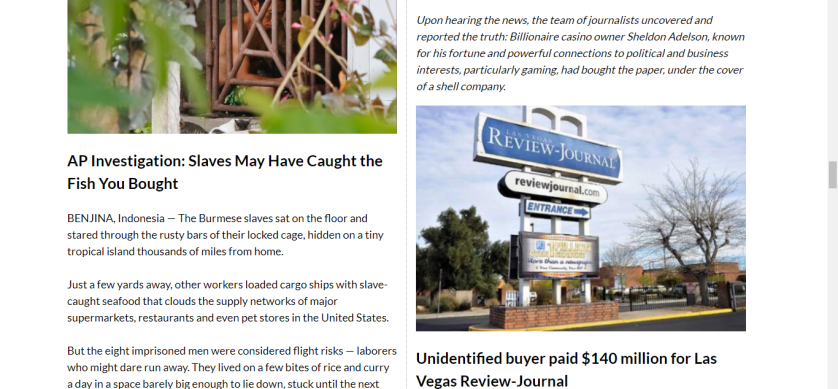
SPJ gives examples of different articles and how they fit ethical journalism.

SPJ puts it clearly: “SPJ Code of Ethics- seek truth and report it, act independently, minimize harm, and be accountable and transparent.”

SPJ’s perspective on what ethical journalism calls for.

How a soldier had PTSD and killed officers; FOIA used to prove it

A former soldier killed five Dallas police officers in July, 2016 during protests after returning overseas on duty. Information about the case was obtained through The Associated Press by the Freedom of Information Act (FOIA). This act allows the public to access data and reports if the information does not contradict any of the exemptions that are set beforehand by the act.

FOIA.gov provides information on the Freedom of Information Act and the exemptions to the act as well.

AP News reported the story of the veteran that was experiencing post-traumatic stress disorder (PTSD) before the murder. It is proven that the 25 year-old man, Micah Johnson was seeking assistance for his anxiety and depression but physicians didn’t think he was at risk of harming himself or others and therefore did not act on his concerns.

jass23
AP News reports a story about a veteran who was experiencing PTSD and kills 5 officers.

Reporters at AP News got their hands of records on the case thanks to the FOIA that stated Johnathan experienced an anxiety attack that required police and made Jonathan feel like, “My heart felt like someone was pinching it while it was beating fast.” Yet even as the soldier told this to doctors, no one diagnosed him with PTSD, something like this discovery could have saved the policemen’s lives.

When I initially finished reading this story, two thoughts came to me:

1) How did the reporters get records of a patient’s health information? Doesn’t this violate exemption 6 of the FOIA which states the FOIA, “Protects information about individuals in personnel and medical files.”

2) Are doctors really the ones to blame for allowing him go out in society? I try to say this with little bias because I’m conflicted with what I’m supposed to think since I try to look at each situation from every angle and give the benefit of the doubt. Why would doctors be dishonest in saying Jonathan was not a harm to himself or society? I don’t think  he was a glaring warning sign to any of these doctors hence them letting go. However, they should have listened to Jonathan’s concerns more carefully and maybe prescribed him medication if symptoms persisted.

Coming from a potential future doctor, I fear ever letting a patient leaving my presence without making an effort to make them feel better. So perhaps Jonathan was at a disadvantage.


Feel like you’ve traveled everywhere just by reading this article

Yes, it is 2018, we have not time traveled but we are traveling instead through different landscapes and climates with the help of The New York Times’ article, “52 Places to Go in 2017.”

Though this article is past due on an update, it still deserves admiration for its layout and quality of visuals.

Moving through this article, readers can get a taste of different countries like India or Canada while getting some information on the place of interest.

For each location, there is a large picture or video that takes up the entire page with a description on what to expect there. Under the text is a map of the destination with links to social media so that readers can discuss with the rest of the web about opinions.

New York Times’ article on places to visit includes large, high-quality pictures to interest readers.
The article includes descriptions as well that are short and sweet followed by a map of the location with social media linked in for easy access to comments.

This is a different take on news stories because it keeps readers interested and awake because of the large and fascinating visuals.

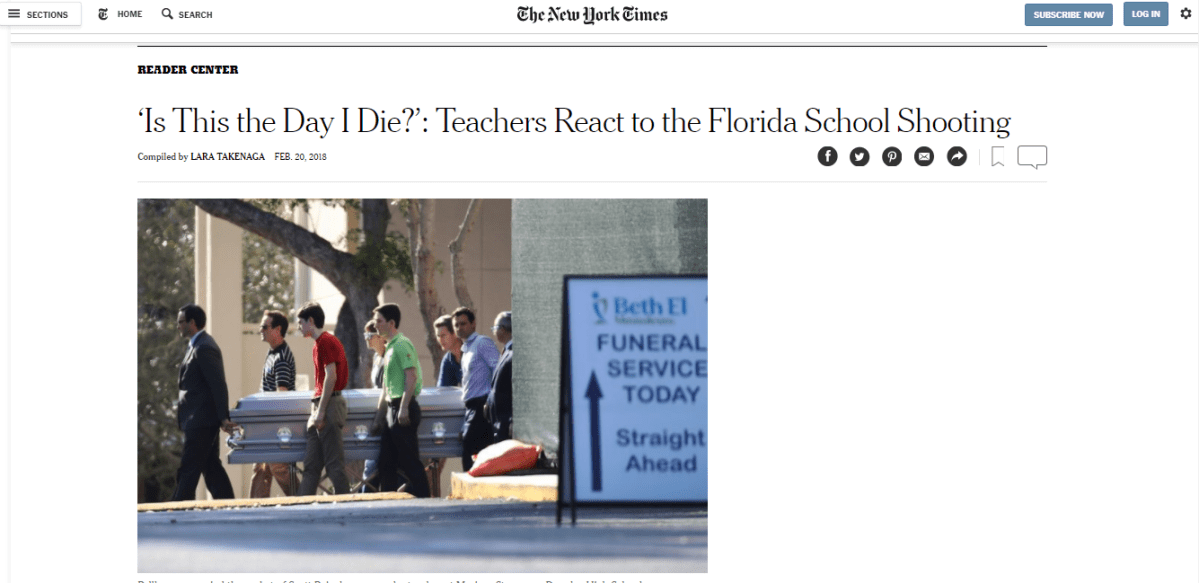
Effective lead in The New York Times’ Florida shooting news story

The recent and unfortunate event of the Florida school shooting has been covered from all angles by different news outlets. Which story do readers notice themselves selecting to read first?

Google search gives many results to the Florida school shooting, which one should be read first or at all?


News stories with descriptive and concise ledes are the ones that attract readers. For example, The New York Times wrote a story,  “‘Is This the Day I Die?’: Teachers React to the Florida School Shooting,” on the Florida school shooting and the fear that exists within teachers all over the country in the midst of violence.

The lede reads, “After the school shooting in Parkland, Fla., last week, The Times heard from many teenagers in the United States who have grown up in an era of school gun violence. We wondered how this climate also affects teachers, the people we trust to protect our children.”

This lede focuses on the “5 W’s and H” which consists of the following:

Who: Teachers

What: How violent climate affects teachers

When: After Florida school shooting

Where: Parkland, Florida

Why: Understand affect on teachers because they are who we trust with our vulnerable loved ones.

How: The Times will listen to different teacher accounts (Implied because they “heard from many teenagers in the United States who have grown up in an era of school gun violence”).

The key to writing a good lede is to include as much as one can in the line without making it too wordy or confusing. Once there’s a good lede, then there are readers pulled in, and it leads to a story being read by many!

Data story that will make you second-guess having kids

Now that I know what data stories are, I’m seeing data everywhere. After watching a movie I think about its ratings, budget, crew demographics, and anything else that can be organized in an excel sheet. I feel enlightened as if I have just taken a stats class.

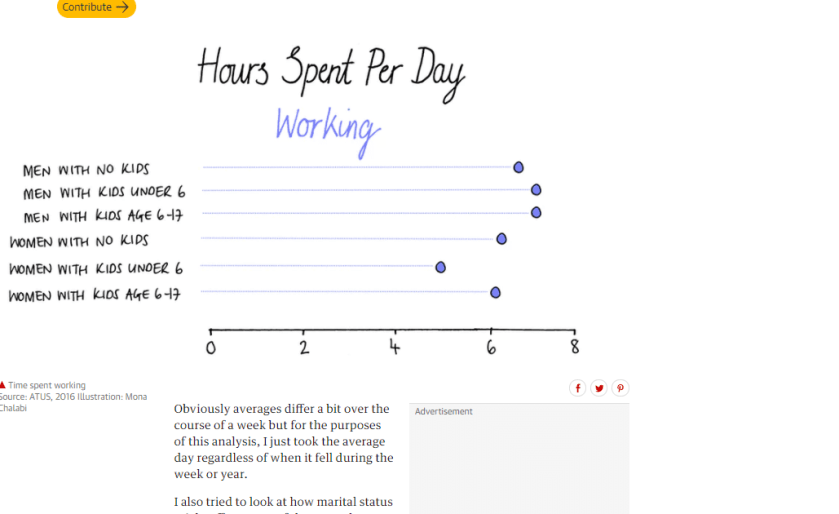
I also am interested in data stories more, like the one by The Guardian that informs readers on just how much time is invested in raising a child titled, “Read this before you have a baby (especially if you’re a woman).”

jass13-e1518509958370.png
Data story by The Guardian.

This data story provides many visuals organizing data like how many hours a day are spent working. This compares the hours of men with no kids to women with kids age 6-17.

Hours spent per day working by parents according to data story by The Guardian.

The next data table presents the amount of hours parents spend per day watching TV. This is a way to break the news that when people have kids, their leisure time goes down dramatically like that of women with kids under the age of 6.

Hours spent per day watching TV by parents. Data story by The Guardian.

Data stories like this help readers visualize data easily and data can then persuade the audience if that’s what the author is trying to do.