Inside Z’s world of social media frenzy

I’ve had social media for a very long time. I started out with MySpace. Unfortunately I do not recall my username or password so a screenshot or link would not be useful at this time.

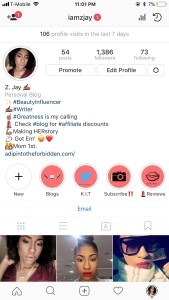
My main social media platform would be Instagram . I use Instagram primarily for photos and to alert the world via hashtags (and those that are following can see as well ) of newly posted blogs. If you were to look at my Instagram today, you would see a lot of makeup photos such as the one below.

Probably should charge my phone!

Another platform I use is Snapchat, when I want to do a quick review on products or just to show a little personality, I’ll do so on Snapchat.

Also Snapchat has the world stories which is new to Instagram. With this feature you’re able to reach a lot of people.

My Twitter is fairly new for me to use, originally I used so I could see the products being shipped in my Ipsy bag prior to receiving them. Now I’ve opened it up publicly. I’ll likely use it the same as I use my Instagram account.

Lastly and most important to me is my Blog. Which is one of the main reasons I took a journalism class. I like to have my own platform where I can voice my own opinions, promote my book and of course do product reviews. On my blog, I’ll have my personal poetry, reviews and affiliate discounts with links. After taking this class I’ll be redoing my whole blog to give it a more professional look rather than the I started in my garage vibe it has currently.

A curation example

On Bridgemi I was able to find an example of curation written by Chastity Pratt Dawsey and Mike Wilkinson. This particular article compared the various school stats in Michigan as opposed to other states. The two reporters highlighted an important fact; “Michigan is not getting the school it deserves.”

I feel that after reading Ron French’s story, which is also on Bridgemi, this was a poor example or perhaps a short article. Although the  article had well over 18 paragraphs and only three contextualized links. As the flow of the paragraphs increased to the end of the article the three links were the only sources that were used.

The article also had related links in the middle of certain paragraphs, that could cause some confusion as you are reading. That could be an added value for citizens in the school districts that want to see similar articles on the topic or as mentioned before cause a sense of confusion to the readers.

I do like the way the few links are attributed, it is the same as what we are currently learning and prior to clicking the link you know what you’re going to potentially be seeing. Thus, it is not click bait. Although this is blog post is not about the content of the writing, I think the authors had too much opinion in the writing. This is something that we should limit as much as possible so that our biases and personal beliefs do not run interference with the facts.

Ron’s Story

Ron French wrote a curated story about Betsy DeVos, that is used as an example for journalism students to study . Within his story he uses multiple sources to create a narrative where his subsequent paragraphs all have an introduction to his sources and contextualized links.

Unlike Bestsy DeVos, he had multiple sources included in his article. One source is from National Assessment of Education Progress (NAEP). This source includes how Michigan schools compare in subjects like math and reading as opposed   to other schools.


Another great source Ron French used in this article besides  Bridgemi.com is Professor Brian A. Jacob who is the professor of education policy, professor of economics and professor of education at the University of Michigan. This professor created an analysis that researched testing scores that have declined over the last 12 years.

The way he uses contextualized links as a way to introduce articles and people is nothing short of genius. He gives a quick summary of the points that are the main focus of the linking article and person. Rather than simply saying “click here” as if click bait, he uses phrases in the sentences to link. In my opinion this also helps the audience understand what they are going to be reading about.

Overall, Ron French made great use of curation techniques within his story that enables the audience to read through the article seamlessly, all while being able to check his sources to ensure they are facts and not speculation.


Trump v.s. DACA and the Democrats

Earlier today, The New York Times wrote a report about the latest of President Trumps infamous tweets. These tweets were about the DACA program and how the Democrats are not supporting him and his administrations plans for Border control.

I enjoyed reading this article due to the aggregation and curation this article provided.

For example, they did not just link the President’s twitter account, but they also posted his tweets for the readers to see, and helps readers to digest the President’s own words.

The article also links to the website about a bipartisan proposal to help immigrant children for those who may not be aware of his previous statements.

How you can find me on socail media

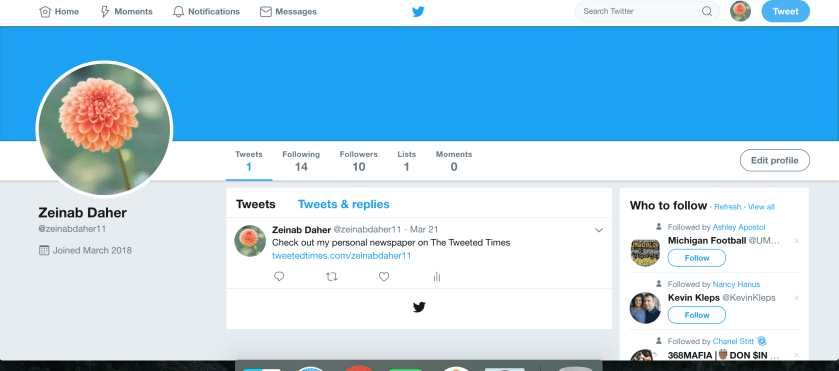
In recent years I haven’t been that active on social media it was never something I personally liked to be on. Recently I have made a twitter account in my journaling class and really seemed to enjoy it. Finding the right username seemed a little tough but I just kept it as simple as zeinabdaher11.

Screen Shot 2018-03-31 at 6.10.15 PM.png

In my journaling class, I learned a lot about TweetDeck. This is a great source I have been using for aggregation and I discovered it while getting the hang of twitter.

Another social media account I have created was my LinkedIn account. Having this social media account helped me connect with people that have the same career interest as me. Also, it’s a great place for job offerings, whether it’s you looking for a job or the job is looking for you.