I chose to write about computer and internet use for individuals 3 years and older in the United States.
The census website provided a detailed data about computer and internet use in the United States by looking at different factors such as age, race, sex, income, region, and education. This data set provided information regarding computer and internet use in 2012.
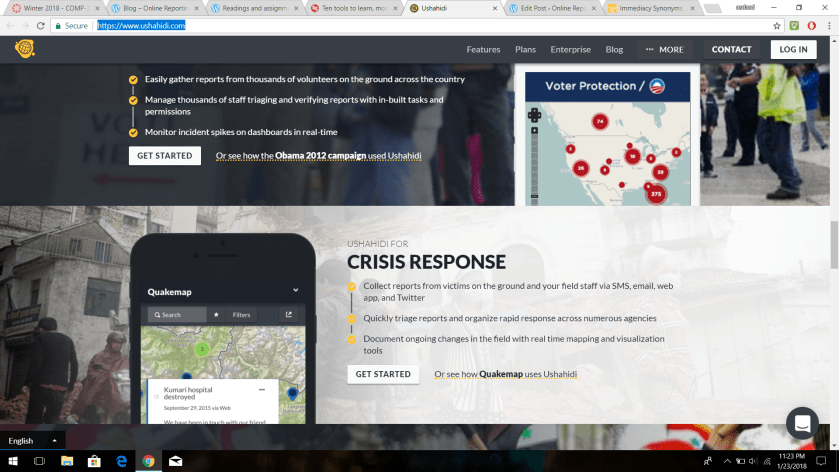
Ushahidi crowd sourced news map of the world gives perspective and immediacy to the news through live updating maps that show exactly where the news is in relation to you.
The website takes news from the citizens of the world, through tweets, data and posts made by members, who then verify its legitimacy, and update a live map of the world. The news appears on the map where its happening, locally or internationally.
Ushahidi was also widely used during the Obama 2012 election. Users could live update the goings on of election day. Whether it be polling to see who is winning in a location or updating the public on issues arising at polling places.
Future prospects of this sort of crowd sourcing information on the fly brings a different take to news that makes it more immediate, more intimate.
The article “More College Students Seem to Be Majoring in Perfectionism” is a very strong article to read, especially as a college student. It gives people the opportunity to understand what is going on in a college student’s mind. It is a very relevant and relatable article with detailed information.
To a parent, college seems to be easy, but times have changed. This article shows the psychology behind the process of how college students view school. Students are more focused on getting a passing grade and turning in the highest quality of work, rather than gaining the knowledge that they are paying to receive.
The study was conducted by the American Psychological Association, and their conclusion is that social media plays a factor in how people view themselves and the effort presented within daily activities. Social media can cause people to view themselves in a negative way, causing pressure on these college students.
Jane Adams, author of the article and a psychologist, made last month’s study clear and able to understand by the public.
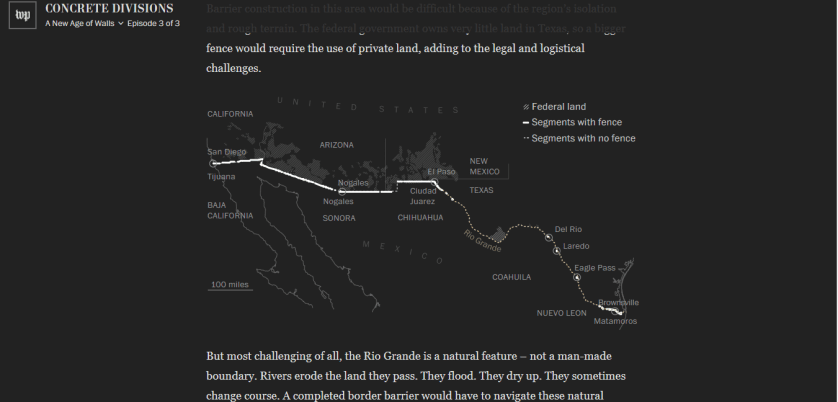
The Washington Post did an incredible job with their interactive news story about borders with barriers across the globe.
The project takes the audience through a series of episodes that have one concentration and allows them to read, analyze maps, and watch videos all at once. The reason this project was so engaging was because of its organization and uniqueness. The videos they included every so often in the piece were short snippets that got straight to the point and were in black in white in order for them to have a specific effect on the audience.
This is a screenshot of the story’s page, giving useful visual aids.
I was moved by this project because here I am, living a comfortable life and I constantly forget that there are people like these refugees that can’t escape to a warm home like me. That’s what’s great about news stories like this, they remind you.
I’m ashamed however at the world in general. The fact that so many countries closed their doors to so many refugees makes me unsure of what to think. Is accepting refugees bad? What if that was us and the tables were turned? The situation in all is very complicated as the authors had mentioned at the end of the article. There’s no straight forward answer.
On one hand I think, these people don’t have food or shelter we must help them. But then I watch the next video in the news project and I see Austria’s struggle to control the population when so many refugees are let into the country- no questions asked. I think to myself, what would I do in a refugee and/or a president’s position? That’s a hard question to even think about.
Many of us have been told ‘be safe on the internet, don’t let anyone know who you are’, but how many of us actually know how to do that? Sure don’t give away your full name or address to people online, but what about the things you don’t have control over like your data uploads and downloads. How do you protect that? Thats where TOR comes in.
TOR stands for ‘The Onion Router’ and what it does is bounce your data between randomly selected predetermined nodes so that data can never be tracked directly back to you. When the data is bounced each node can only see the previous node the data came from and the next node the data is going to so no node knows the complete path the data took.
But why is it important to hide your digital footprint? With TOR individuals can access news sites, chat rooms, or other websites that are blocked by their internet service provider. Journalists can use it to safely connect to whistleblowers when other methods of contact would be to risky. On TOR’s own website they even claim that certain branches of the U.S. Navy uses TOR for open source intelligence gathering.
So next time you need to hide your personal data check out TOR for a secure connection.




 Online Reporting, Research & Writing