How ledes can capture your attention

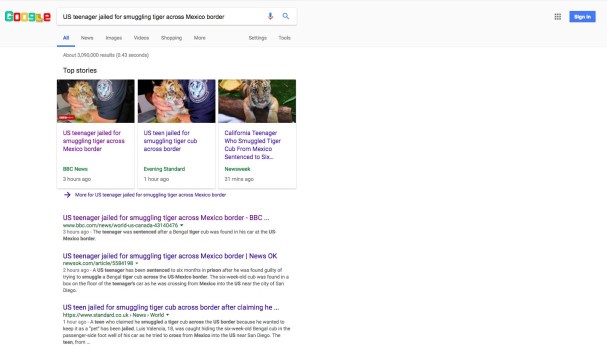
Today, I clicked on the news tab on Google and was looking at the headlines. One headline caught my eye. It was U.S teenager jailed for smuggling tiger across Mexico border. The headline made me curious about what happened, so I clicked the article and read it.

news

The lede from the article is “A US teenager has been sentenced to six months in prison after he was found guilty of trying to smuggle a Bengal tiger cub across the US-Mexico border. The six-week-old cub was found in a box on the floor of the teenager’s car as he was crossing from Mexico into the US near the city of San Diego.”

The lede does capture the 5 W’s and H.

Who: A U.S teenager

What: Sentenced to six months in prison

Where: U.S and Mexico

When: After smuggling a Bengal tiger

Why: Smuggling a Bengal tiger

How: The teenager’s car
news2

The images the article included were pictures of the tiger. The story happened in August 2017, but the sentencing happened today. There’s a link to the original article and other related links about the smuggling of exotic animals.

When googling the headline, there are other links from various media outlets that covered the same story. The image that shows up is the picture of the Bengal tiger that was taken in 2017.
Gun ownership and gun homicide interactive map

During my Public Health course, my professor wanted to talk about the recent school shooting in Florida. She wanted us to me informed about the importance of knowing the dangers of guns and talk about ideas to stop what’s happening. She shared a lot of data charts and articles and I managed to find a few of them.

Gun Violence Archive

Mass shooting: How U.S gun culture compares with the rest of the world

Gun Policy

10 Pro – Gun Myths, Shot Down

Trump Signs Bill Revoking Obama-Era Gun Checks for People with Mental Illnesses

Gun Violence by The Numbers

map

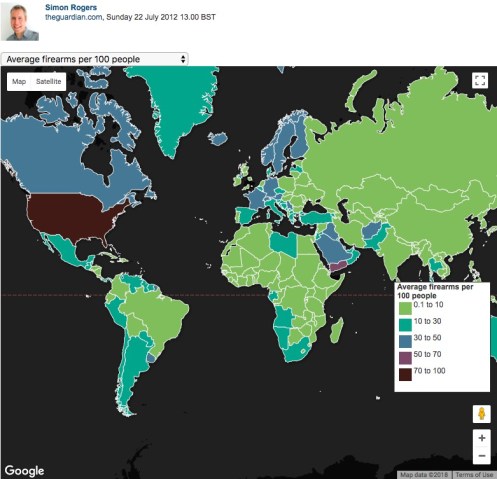
When finding these sites, I found an interactive map that shows the gun ownership and gun homicides of the world. You can click on any country and it will give you the rank of the country of ownership of guns and the number of homicides in the past year. You can also look at homicide by firearm per every 100,000 population and percent of homicide by firearm.

Out of the whole world, the U.S is ranked 1st in civilian gun ownership that averages 70 – 100 firearms per 100 people.

They also have a link to a Google fusion table that shows all the countries and the statistics of each of them.

What makes a good lead

A good lead has to be informative, where it has to explain the what, when, where, why, who, and how of the story. Also, a good lead has to have a good headline that draws the reader and gives information on what the story will be about.

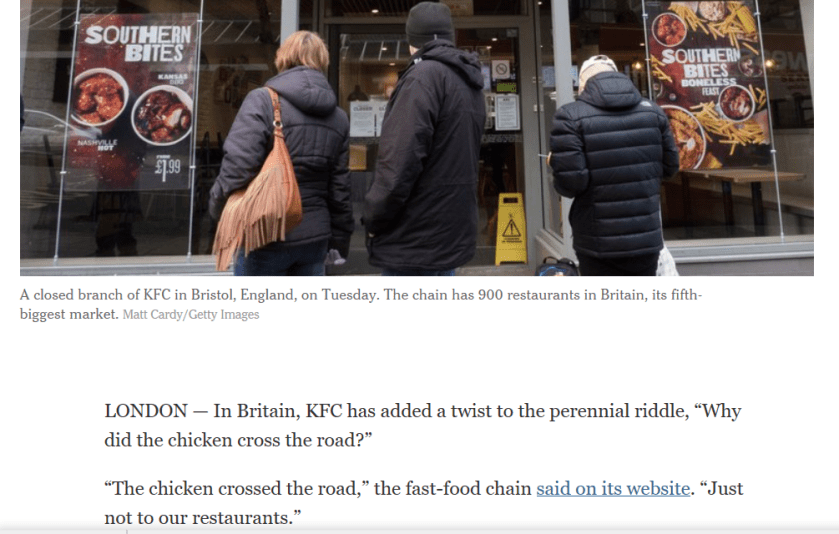
The KFC Has a Problem in Britain: Not Enough Chicken article in the New York Times is a good example of what a good lead looks like. The 5 W’s and H were answered in the lead of the story. The lead of the KFC Has a Problem in Britain: Not Enough Chicken article had a good headline, where I was drawn into the topic just by reading the first two sentences in the article. The lead of the KFC Has a Problem in Britain: Not Enough Chicken article summarized the main idea in the whole story. As a reader, I was able to know what the article was going to be about just by reading the lead of the article.

The KFC Has a Problem in Britain: Not Enough Chicken article is a well-written article because it had a good lead, and it included a picture, resources, and links to support the information presented in the article. The provided resources in the article gave it more credibility to its readers.

I googled the headline of the KFC Has a Problem in Britain: Not Enough Chicken article, and the first option in the google search was the actual article in the New York Times website. The second option in the search was a YouTube video from the CBRT news that is talking about the same story. However, there were no images shown in the google search, and I had to go to google images to see the image that was in the New York Times post as the first image.

blog9

Feel like you’ve traveled everywhere just by reading this article

Yes, it is 2018, we have not time traveled but we are traveling instead through different landscapes and climates with the help of The New York Times’ article, “52 Places to Go in 2017.”

Though this article is past due on an update, it still deserves admiration for its layout and quality of visuals.

Moving through this article, readers can get a taste of different countries like India or Canada while getting some information on the place of interest.

For each location, there is a large picture or video that takes up the entire page with a description on what to expect there. Under the text is a map of the destination with links to social media so that readers can discuss with the rest of the web about opinions.

New York Times’ article on places to visit includes large, high-quality pictures to interest readers.
The article includes descriptions as well that are short and sweet followed by a map of the location with social media linked in for easy access to comments.

This is a different take on news stories because it keeps readers interested and awake because of the large and fascinating visuals.

Effective lead in The New York Times’ Florida shooting news story

The recent and unfortunate event of the Florida school shooting has been covered from all angles by different news outlets. Which story do readers notice themselves selecting to read first?

Google search gives many results to the Florida school shooting, which one should be read first or at all?


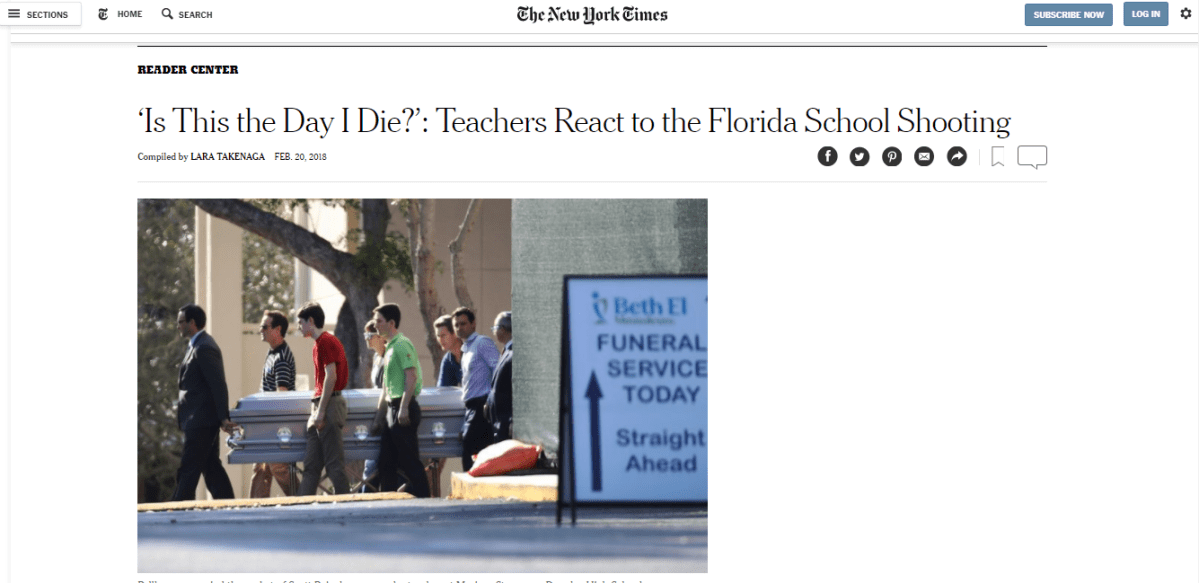
News stories with descriptive and concise ledes are the ones that attract readers. For example, The New York Times wrote a story,  “‘Is This the Day I Die?’: Teachers React to the Florida School Shooting,” on the Florida school shooting and the fear that exists within teachers all over the country in the midst of violence.

The lede reads, “After the school shooting in Parkland, Fla., last week, The Times heard from many teenagers in the United States who have grown up in an era of school gun violence. We wondered how this climate also affects teachers, the people we trust to protect our children.”

This lede focuses on the “5 W’s and H” which consists of the following:

Who: Teachers

What: How violent climate affects teachers

When: After Florida school shooting

Where: Parkland, Florida

Why: Understand affect on teachers because they are who we trust with our vulnerable loved ones.

How: The Times will listen to different teacher accounts (Implied because they “heard from many teenagers in the United States who have grown up in an era of school gun violence”).

The key to writing a good lede is to include as much as one can in the line without making it too wordy or confusing. Once there’s a good lede, then there are readers pulled in, and it leads to a story being read by many!