Elements of Style provides a refresher on grammar, punctuation

As I mentioned the first day of class, “The Elements of Style” by Strunk & White is a quick read but an invaluable one for everyone who needs to brush up on grammar and punctuation. I think the punctuation pieces of this book are especially relevant for some of you in this class.

So I’m linking here to the free online version of the book, and I am suggesting specifically the elements related to commas (it’s the first major section). I’m seeing in a lot of your work a lack of commas — and this text is GREAT at explaining exactly when to use them and when to leave them out.

I hope it’s helpful!  I find myself reading elements of this book every once in a while to remind me to stay sharp when writing.


Using census data to improve stories

There are many data sources out there to help writers enhance their stories. From sport stats to disease control outlets, there are endless options to choose from in order to increase your credibility.

I specifically took interest in the United States Census Bureau‘s website. It was helpful in directing me to my topic of interest and deriving some stats from it.

For example, I’m interested in poverty rates because I wish to open free clinics in poverty-stricken areas when I advance in my medical career. The Census Bureau had useful data to provide to me so I could get a better idea of what I was looking for.

To go more in depth, it gave me data collections that connected the keyword “poverty” to “insurance”.

The Census Bureau has data focusing on health insurance and poverty of American citizens.


It is easy to retrieve data on anything you’re interested in. I believe the Census Bureau’s website is useful in articles that are informative because it allows us to look at data from a large scope like the amount of Asians in America to specific cases like the following:

Table of the Percentage of People by Type of Health Insurance Coverage by United States Census Bureau.

Looking at data sources like this, it allows me to be more creative and credible with future posts. When in doubt, look for data on the topic your writing about, you’d be surprised at what you find.

Michigan college comparison data story

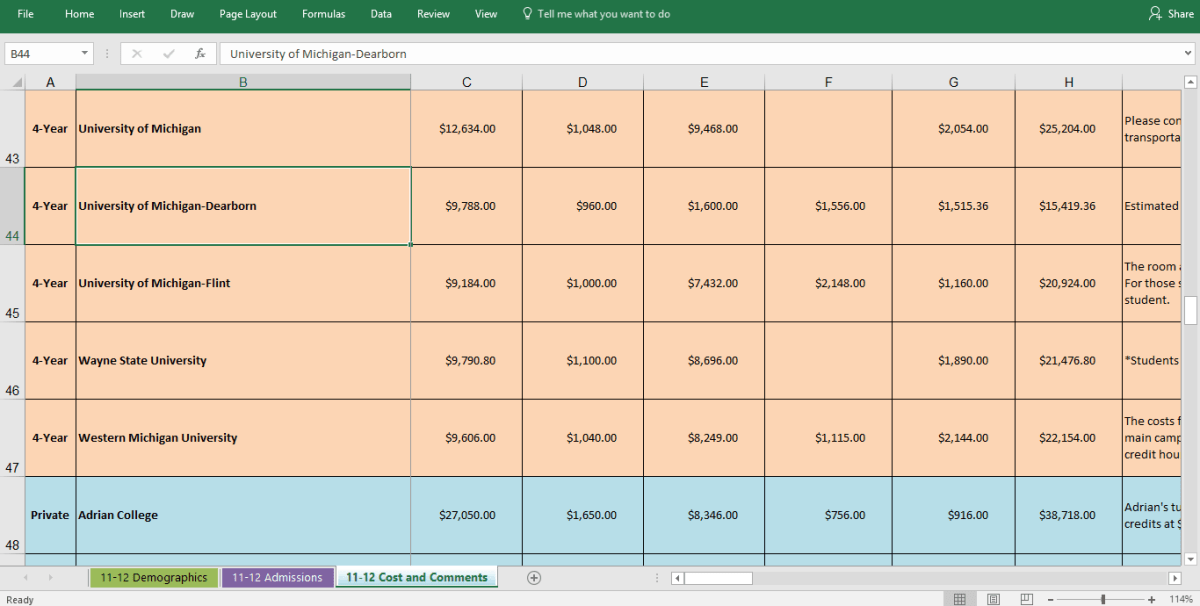
Using Google’s Advanced Search Engine I was able to find different collections of data regarding Michigan Colleges including one I used to make a data story out of. This was an Excel sheet that covered the demographics, admission basics, and costs of Michigan colleges from 2-year, 4-year, and private schools.

Using Google’s Advanced Search to find Excel formatted data of Michigan colleges.

The section that was of most interest to me was the costs of the colleges. I was able to manipulate the data and sort it from most to least expensive universities in Michigan using the Sort and Filter tool on Excel. This allowed me to see exactly how much each university costs to attend and was helpful in organizing information in the way I needed in order to make my data story.

In fact, in terms of total expenses including tuition and fees, books and supplies, room and board, transportation, and expenses for in-state freshmen of 4-year Michigan Universities, University of Michigan-Dearborn was the least expensive. It makes me proud to know that I can get a great education at a school that is rather affordable!

Sample of the data in the college comparison excel sheet.

Aggregating News around the World

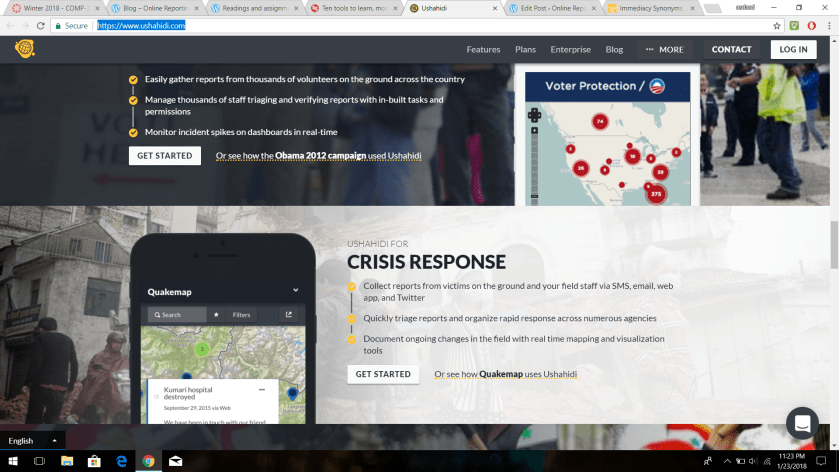
Ushahidi  crowd sourced news map of the world gives perspective and immediacy to the news through live updating maps that show exactly where the news is in relation to you.

The website takes news from the citizens of the world, through tweets, data and posts made by members, who then verify its legitimacy, and update a live map of the world. The news appears on the map where its happening, locally or internationally.

Screenshot (12).png

Ushahidi was also widely used during the Obama 2012 election. Users could live update the goings on of election day. Whether it be polling to see who is winning in a location or updating the public on issues arising at polling places.

Future prospects of this sort of crowd sourcing information on the fly brings a different take to news that makes it more immediate, more intimate.